

Red Light, Near-Infrared & Blue Light Therapy: What Each Wavelength Actually Does — and How to Use It
If you’ve been curious about light therapy but confused by all the wavelengths, panels, and claims floating around the internet, you’re not alone. The science is real — but it’s nuanced. Different wavelengths of light do very different things in the body, penetrating to different depths and triggering different biological responses. Let’s break it all down.
Why Light Affects the Body at All
Your cells — particularly the mitochondria, which are your cellular energy factories — respond to specific wavelengths of light. When the right wavelengths hit the right tissues, they trigger a process called photobiomodulation (PBM): essentially, light energy is absorbed and converted into cellular energy in the form of ATP (adenosine triphosphate). More ATP means more fuel for healing, repair, regeneration, and inflammation control.
Research published in JAMA Dermatology and multiple peer-reviewed journals has confirmed that specific wavelengths of light can meaningfully impact cellular function, inflammation, circulation, and recovery — making light therapy one of the more exciting tools in the modern wellness toolkit.¹
Blue Light (415–470 nm)
Penetration depth: 0.5–1 mm (epidermis only)
Blue light is visible to the eye and stays very shallow — it barely reaches past the surface of the skin. That’s not a flaw; it’s actually what makes it useful for specific surface-level applications.
415–430 nm is used clinically for acne, oily skin, and bacterial skin conditions. At this wavelength, blue light targets and destroys Cutibacterium acnes (formerly P. acnes), the bacteria responsible for inflammatory acne, without the side effects of topical antibiotics.² It’s one of the most well-supported dermatological uses of light therapy.
450–470 nm shifts the benefit from skin to brain and circadian rhythm. At these wavelengths, blue light stimulates the melanopsin receptors in your eyes, suppressing melatonin and promoting alertness — which is why it’s used therapeutically for seasonal affective disorder (SAD), morning alertness, and circadian rhythm resetting.³
⚠️ Important caveat: Because blue light suppresses melatonin, exposure should be avoided in the evening. Nighttime blue light exposure — from computer, iPad, and phone screens, overhead lighting, or devices — is strongly linked to disrupted sleep quality and worsened circadian rhythm.⁴ Use blue light therapy in the morning only.
Red Light (620–660 nm)
Penetration depth: 2–10 mm (epidermis through dermis and into superficial tissue)
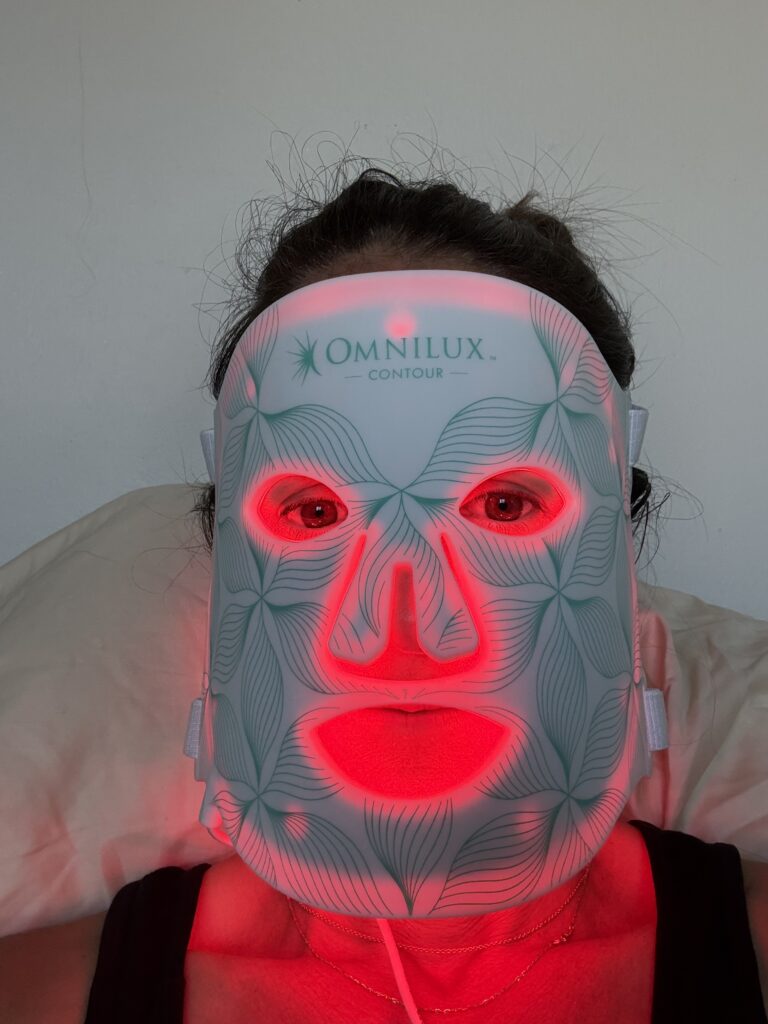
Red light is visible (that warm red glow you see on panels) and works primarily at the skin and superficial tissue level. This is the most well-studied range in light therapy, with hundreds of peer-reviewed trials behind it.
620–630 nm targets the skin surface and is used for skin rejuvenation, fine lines and wrinkles, pigmentation issues, wound healing, scar reduction, and mild surface inflammation, penetrating 2–4 mm into the epidermis and dermis. Studies show red light in this range stimulates fibroblast activity and collagen synthesis, making it one of the most evidence-backed non-invasive anti-aging tools available.⁵
640–660 nm goes slightly deeper — 5–10 mm — reaching muscle tissue, tendons, ligaments, and hair follicles. This range is best for muscle recovery, joint pain, tendon and ligament repair, athletic recovery, arthritis, and hair follicle rejuvenation. It is also the most studied red light wavelength overall, and is almost always paired with 850 nm near-infrared in quality panels because the two wavelengths complement each other beautifully — red working on superficial tissue while NIR works deep.⁶
Near-Infrared Light (810–1060 nm)
Penetration depth: 2–5 cm (muscles, joints, nerves, and bone)
Near-infrared (NIR) is invisible to the naked eye — you won’t see it glowing — but it penetrates dramatically deeper than red light, reaching muscles, joints, nerves, and even bone. It has some of the most exciting research behind it, particularly around mitochondrial function, brain health, and deep tissue recovery.
810 nm is arguably the most powerful wavelength for brain health and mitochondrial support. At this frequency, NIR light crosses thin-bone areas of the skull and directly influences brain tissue — improving blood flow, reducing neuroinflammation, supporting cognitive function, mood, and nerve regeneration. It has been studied in the context of depression, Parkinson’s disease, Alzheimer’s disease, and traumatic brain injury.⁷ Penetrating 2–3 cm, it is also highly effective for mitochondrial dysfunction throughout the body.
830 nm is the go-to for deep tissue repair and chronic inflammation control. At 3–4 cm penetration, it reaches ligaments, tendons, joint capsules, and deep muscle tissue — making it a staple in physical therapy, sports medicine, and post-surgical recovery. Research supports its use for arthritis, chronic pain, and accelerated tissue healing.⁸
850 nm goes deepest at 4–5 cm, making it the most effective NIR wavelength for bone healing, deep joint pain, fracture recovery, muscle recovery, and circulation via vasodilation. This is the wavelength most commonly combined with 660 nm red light on consumer and clinical panels, and is also frequently added to PEMF (pulsed electromagnetic field) devices as a complementary modality.⁹
Far-Infrared (3,000–100,000 nm)
Penetration depth: 3–4 cm (tissue heating)
Far-infrared (FIR) operates in a completely different way than the wavelengths above. Rather than triggering photobiomodulation at the cellular level, FIR works primarily through thermal effects — it heats the tissue directly, which sets off a cascade of beneficial physiological responses.
This is the technology behind infrared saunas. FIR penetrates tissue and raises core body temperature, which triggers sweating and detoxification, vasodilation and improved circulation, cardiovascular conditioning (your heart rate elevates similarly to mild exercise), deep muscle relaxation, and improved flexibility. Research has also shown that regular far-infrared sauna use can reduce blood pressure, support cardiovascular health, and lower systemic inflammation markers.¹⁰
Quick Reference Guide
| Wavelength | Type | Depth | Best For |
|---|---|---|---|
| 415–430 nm | Blue | 0.5–1 mm | Acne, bacteria, oily skin |
| 450–470 nm | Blue | Eyes only | Circadian rhythm, SAD, alertness |
| 620–630 nm | Red | 2–4 mm | Skin rejuvenation, collagen, wound healing |
| 640–660 nm | Red | 5–10 mm | Muscle recovery, joint pain, hair growth |
| 810 nm | Near-Infrared | 2–3 cm | Brain health, mitochondria, mood, nerves |
| 830 nm | Near-Infrared | 3–4 cm | Deep tissue, chronic inflammation, PT/surgery |
| 850 nm | Near-Infrared | 4–5 cm | Bone healing, deep joints, circulation |
| 3,000–100,000 nm | Far-Infrared | 3–4 cm | Sauna, detox, cardiovascular, relaxation |
Your LED Bulbs May Be Silently Damaging Your Mitochondria
In December 2025, neuroscientist Dr. Glen Jeffery — a professor at University College London and one of the world’s leading experts on light and cellular health — appeared on the Huberman Lab podcast and dropped some genuinely eye-opening findings.
This is the part of Dr. Glen Jeffery’s work that deserves its own section — and a serious conversation. Modern LED lighting, which now dominates our homes, offices, and screens, is heavily weighted toward short, high-energy blue wavelengths. And according to Dr. Jeffery, this is not a minor concern.
In his lab’s experiments, mice exposed to LED lighting showed impaired glucose metabolism, weight gain, and liver problems. Watching mitochondria under LED exposure, Dr. Jeffery described seeing them “gently go downhill.” He has compared the potential long-term public health impact of widespread LED adoption to the asbestos crisis — a slow-moving, invisible harm that we may not fully reckon with for decades.
How to Use Light Therapy for Your Health
A few general guidelines:
- Consistency matters more than intensity. Most research protocols use 10–20 minute sessions, 3–5 times per week
- Distance matters. For red and NIR panels, 6–12 inches from the body is the standard range — closer isn’t always better
- Timing matters for blue light. Morning only. Never at night
- Clothing does not block it. You don’t need to be in minimal clothing for red and NIR light therapy to work. Long wavelengths pass through fabric. While skin exposure may slightly increase surface-level benefits for skin health, the deeper mitochondrial and metabolic effects occur regardless of what you’re wearing. See Dr. Glen Jeffery on Huberman podcast.
- Red light penetrates the whole body regardless of where it enters- Dr. Glen Jeffery explains that red light penetrates the whole body regardless of where it enters. This is one of the most important and underappreciated facts about long-wavelength light. Because of how light scatters through tissue, red and NIR wavelengths don’t just work locally at the skin surface — they travel through the body systemically. This means you don’t need to target every body part individually. Your mitochondria throughout your entire body can benefit from a single session in front of a panel. See Dr. Glen Jeffery on Huberman podcast.
- Eye protection is recommended for high-powered NIR panels, especially around the 810 nm range
- Timing is everything — use it before noon. Dr. Jeffery’s research points to a critical insight: your mitochondria follow a circadian rhythm, just like the rest of your body. They are most responsive — most “awake” — in the morning hours. Using red light therapy before noon aligns with your mitochondria’s natural peak activity window, maximizing the energy and healing benefits. Using it at night risks stimulating mitochondrial activity right when your body is trying to wind down and repair during sleep. Morning use is optimal. See Dr. Glen Jeffery on Huberman podcast.
- Just three minutes can make a measurable difference. One of the most striking findings from Dr. Jeffery’s lab: just three minutes of exposure to 670 nm deep red light improved visual function by 20%, with effects lasting up to five days. This has significant implications for eye health and suggests that even short, consistent sessions can produce meaningful biological change. See Dr. Glen Jeffery on Huberman podcast.
What you can do right now:
- Replace overhead LEDs in your home — especially in your bedroom and evening living spaces — with incandescent or halogen bulbs, which emit a warmer, fuller spectrum closer to natural light
- Add plants near your windows — plants reflect infrared light back into your indoor environment, partially offsetting the loss of long-wavelength light that modern windows and building materials tend to block
- Get morning sunlight — sunlight remains the original and most complete source of full-spectrum light, including the long wavelengths your mitochondria crave
- Use screens with night mode in the evening, and consider blue light blocking glasses after sunset
The takeaway: red light therapy isn’t just about adding something beneficial to your routine. It’s also about correcting a deficit that modern indoor living has created.
Product Recommendations
If you’re looking to invest in a quality panel, here are some of the most respected options on the market:
🔴 Hooga Ultra Series A strong value option for those wanting clinical-grade wavelengths (660 nm + 850 nm) without the premium price tag. The Ultra series offers higher irradiance than Hooga’s base models and is a great entry point for full-body red and NIR therapy.
🔴 Mito Pro X Series A high-performance panel with excellent irradiance output and multiple wavelength options including 630, 660, 810, 830, and 850 nm. Great for those who want broader wavelength coverage in a single panel.
🔴 Joovv One of the most well-known brands in consumer red light therapy, Joovv panels are FDA-registered and backed by solid research partnerships. Their modular system allows you to build out full-body coverage over time. Premium price point, premium build quality.
🔴 PlatinumLED BioMax Series Widely considered one of the best consumer panels available. The BioMax uses a 5-wavelength combination (630, 660, 810, 830, 850 nm) giving you coverage across both red and near-infrared ranges simultaneously. Exceptional irradiance, solid build, and a strong value for the quality.
The Bottom Line
Light therapy isn’t one-size-fits-all — the wavelength determines everything. Blue light stays at the surface and influences your skin and circadian biology. Red light works on your skin, muscles, and tendons. Near-infrared goes deep into your body and powerfully supports mitochondrial function, brain health, and tissue repair. Far-infrared heats you from the inside out, supporting detoxification and cardiovascular health.
Used consistently and correctly, light therapy is one of the most evidence-backed biohacking tools available — and it’s only getting more accessible.
If you want to do a deeper dive, check these podcasts (1) Huberman Lab, Dec. 1, 2025 with Dr. Glen Jeffery Using Red Light to Improve Metabolism and the Harmful Effects of LEDs (2) The Tim Ferris Show #823 with Dr. Jeffrey Goldberg: Creating Supranormal Vision, Cutting-edge Science for Eye Health, Supplements, Red light therapy, and the Future of Eyesite Restoration.Citations:
- Hamblin MR. Mechanisms and applications of the anti-inflammatory effects of photobiomodulation. AIMS Biophysics. 2017.
- Elman M, Lebzelter J. Light therapy in the treatment of acne vulgaris. Dermatologic Surgery. 2004.
- Lewy AJ, et al. Antidepressant and circadian phase-shifting effects of light. Science. 1987.
- Chang AM, et al. Evening use of light-emitting eReaders negatively affects sleep. PNAS. 2015.
- Avci P, et al. Low-level laser therapy for fat layer reduction. Lasers in Surgery and Medicine. 2013.
- Chung H, et al. The nuts and bolts of low-level laser therapy. Annals of Biomedical Engineering. 2012.
- Hennessy M, Hamblin MR. Photobiomodulation and the brain. Journal of Optics. 2017.
- Huang YY, et al. Biphasic dose response in low level light therapy. Dose-Response. 2009.
- Sene-Fiorese M, et al. The potential of phototherapy to reduce body fat. Lasers in Surgery and Medicine. 2015.
- Crinnion WJ. Sauna as a valuable clinical tool. Alternative Medicine Review. 2011.
- Jeffery G, Huberman A. Using Red Light to Improve Metabolism & the Harmful Effects of LEDs. Huberman Lab Podcast. December 1, 2025.